


When water started to seep into her basement on the evening of Jan. 15, Kayla Smith didn’t panic. Since buying her house on Southern Avenue SE in 2019, she has dealt with several nuisance flooding issues, usually during heavy rainfall.

She first called DC Water, as she normally would, around 9 p.m. As the night wore on, though, Smith quickly realized this was not her typical flood issue.
“We kept calling every hour, to say ‘hey, it’s still rising,’” Smith said in an interview outside her home a few days after the flood. “‘This doesn’t look like rainwater—this looks gross and disgusting.’”
A sewer main, situated just over the Maryland border, had collapsed. At least 15 homes on Southern Avenue Southeast and Fort Dupont Street Southeast experienced some effects from the flooding, according to WSSC Water, the utility responsible for the pipe.
Raw sewage poured into basements throughout the night. DC Water workers did not arrive until after 10 the next morning. The pipe’s collapse occurred both on a holiday—Martin Luther King, Jr. Day—and during a heavy snowstorm.
“We are still investigating the circumstances, but there are indications that weather conditions and available staffing may have impacted the initial response,” DC Water spokesperson John Lisle said in an emailed response to the Informer.
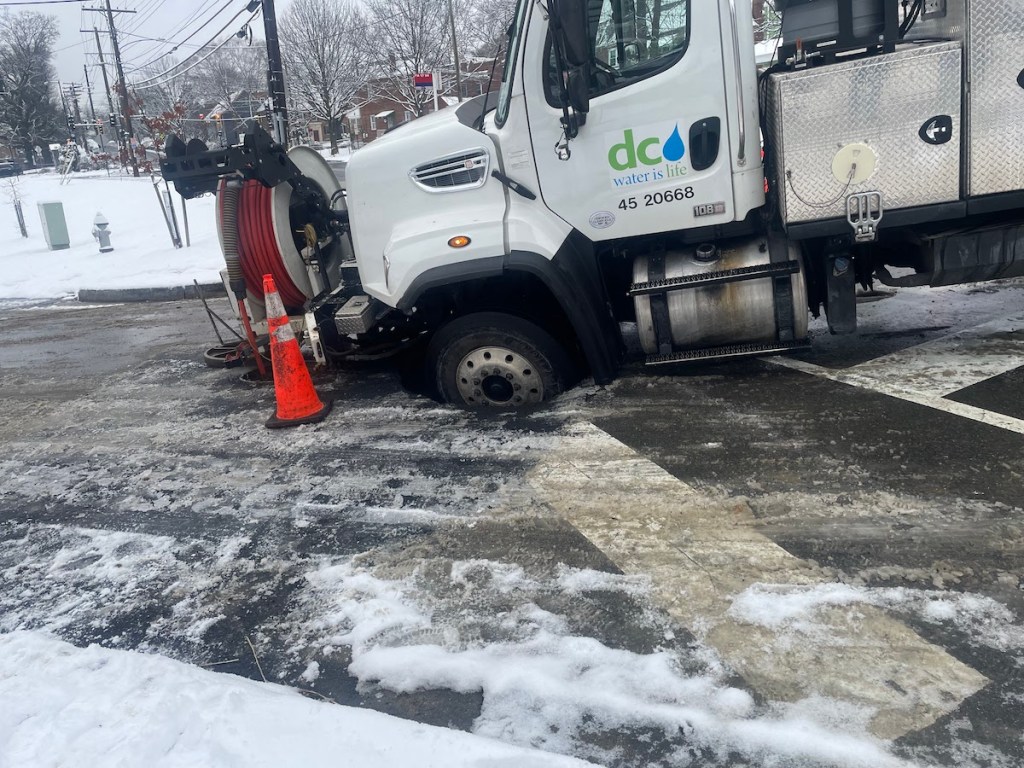
When the first DC Water employees came in the morning, one of their trucks fell into the hole in the road around the broken pipe and got stuck for hours.
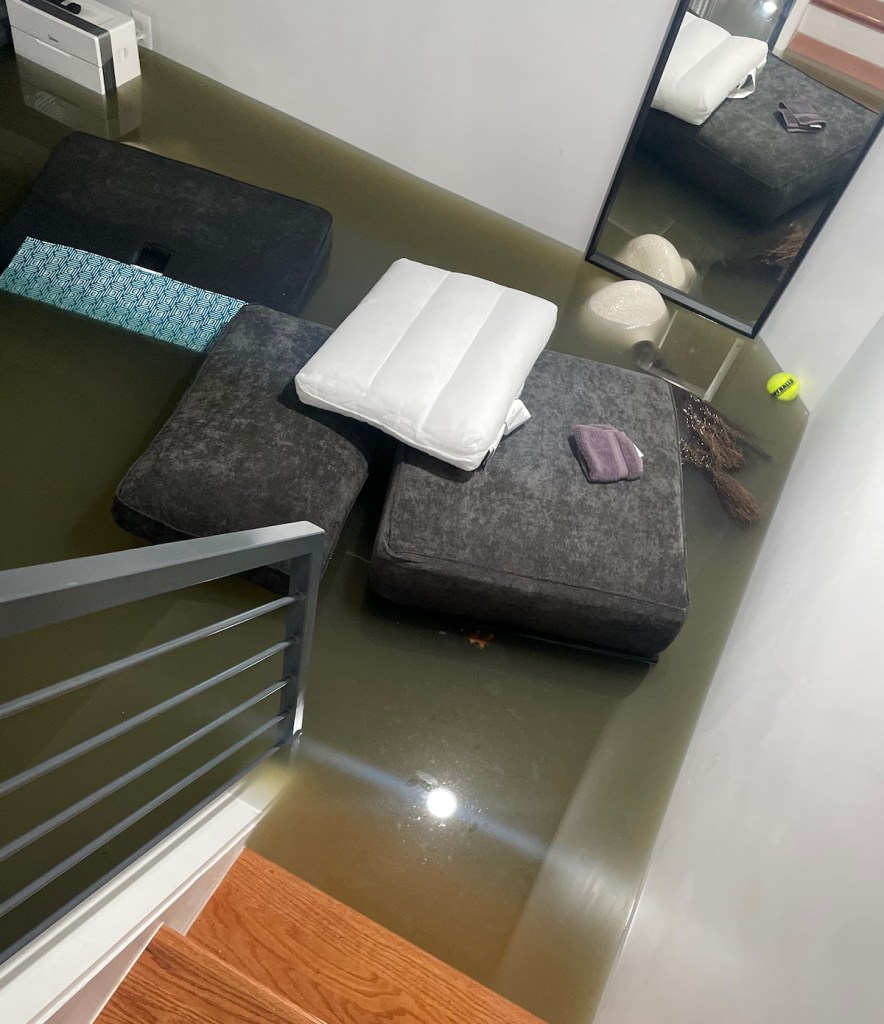
Meanwhile, Smith had at least two feet of raw sewage in her basement. One of her next-door neighbors, Khianti Silver, told WUSA9 that wastewater started coming out of the showerhead in her basement bathroom during the night. The water destroyed thousands of dollars’ worth of furniture, appliances and other belongings in people’s homes.
“I had a brand new 65-inch TV, floating,” Smith said. “My sofa was floating—so much water that it raised it off the ground. It wasn’t just submerged, it [was] literally floating around.”
Once it became clear that the breakage was on WSSC Water’s side of the border, repairs could start to happen. Workers had fixed the pipe by the end of the day on Jan. 16, said Lyn Riggins, a spokesperson for the utility.
The sewer main itself was a 10-inch diameter clay pipe, first put into place in 1941, according to Riggins. Days before the pipe broke, neighbors had seen a crew out digging at the same spot. Riggins said it was WSSC contractors, and the company is looking into whether the recent work could have contributed to the pipe’s collapse.
“There was sewer rehabilitation work in the area. We are investigating if there is any connection,” she said in an email.
As soon as the pipe was repaired and sewage stopped backing up, WSSC Water sent cleanup crews to impacted homes.
Agencies ‘Stepped Up’ After Neighbors Worked Together to ‘Raise a Fuss’
As sewage was filling their basements, Smith and her neighbors were not just calling DC Water—they were reaching out everywhere. They contacted the offices of Ward 7 councilmember Vince Gray and the mayor.
Then they brought their story to social media, where the popular account Washingtonian Problems posted their message and photos on both Instagram and X (formerly Twitter). The Instagram post garnered thousands of likes and hundreds of comments—and caught the eye of local TV news stations. Smith thinks that may have made a big difference.
“[WSSC workers] were just on top of it, working through the night; they’re showing up at 7 a.m. to do inspections,” Smith said. “They have been fantastic, and I think a large part of that is due to the media response. It’s been a real communal effort.”
The repair work is an enormous undertaking for many of the homes’ basements, where several feet of drywall and all flooring had to be completely ripped out and replaced. Some homeowners stayed in hotels—paid for by WSSC Water—during the week after the flood. The water had completely knocked out some homes’ furnaces and boilers at the start of a bitterly cold week, with temperatures dropping as low as 16 degrees.
Smith went back and forth, staying at her home during daylight hours so that her dog, Kylo, could run around in the backyard.
“I’m kind of bracing and bearing with the cold during the day, and then I leave by the time the sun goes down—‘cause that’s when it gets really cold,” Smith said.
As of Jan. 23, a full week after the incident, the heat in several of the homes on the block had been restored. Smith’s home, however, remained without gas, though workers told her it would be repaired soon.
“After we had kind of raised a fuss and stomped our feet a little bit, I do feel like everyone is stepping up to make sure that this gets resolved in the quickest way possible,” Smith said.
Both DC Water and WSSC deployed community outreach specialists in the neighborhood to connect with residents and help coordinate resources. Still, Smith worried about whether everyone affected by the flooding had been able to tap into the resources being offered. She saw a number of private plumbers, unconnected to WSSC’s response, drive by on Fort Dupont Street SE in the days immediately after the flood.
“Anyone who was on this row saw DC Water, they saw WSSC, they saw the reporters,” Smith said. “But if you’re on that side, you wake up, and there’s sewage, and you’re not used to your city looking out for you—you don’t know to call the city, you don’t know to ask questions… There needs to be more outreach for Ward 7 and 8 on what resources are actually available for them, and how the city can actually show up for them in times of crisis.”
Beyond the Broken Sewer Main
When the sewage flood first occurred, Smith said she felt “furious, neglected, abandoned.” But things improved as institutions worked in her home and behind the scenes to resolve the issue over the following days. Neighbors received apologetic phone calls from WSSC’s general manager, and Smith felt that community members and officials alike had been empathetic and responsive to the crisis.
“It does feel like people have understood our loss,” Smith said. “It took them seeing it, to be honest. You hear the word ‘flooding’ and everyone has a different version of what flooding looks like. It took them walking down our steps and seeing feet of water… for them to really understand what was going on.”
Sewer main accidents of that scale are not super common in the D.C. area. But basement flooding from heavy rainfall—which can sometimes also cause sewage backups—happens all the time, including on that same block of Southern Avenue SE.
Smith said she and her neighbors keep wet vacuums ready whenever it rains. Some homeowners have installed sump pumps or backwater valves to help keep the water out—but those improvements can cost thousands of dollars.
“It is the reality of living in a place where your buildings are old,” Smith said. “With every rain, it is a possibility that you flood—it may not always happen, but you prepare yourself emotionally.”
Smith’s block is nowhere near a designated flood zone on the maps created by the Federal Emergency Management Agency. That’s because FEMA’s maps tend to focus almost entirely on the types of flooding that come from rivers or coastlines overflowing, rather than the urban flooding that occurs when rainfall overflows storm drains far from any body of water.
The District is working on creating an “integrated flood model,” which would map where flooding issues occur in the city beyond the FEMA designations. But that model is not set to be finished until next year, according to an Action Plan document produced by the D.C. Flood Task Force.
Heavy rainfall events are becoming more frequent because gasses from burning fossil fuels are trapping heat in the atmosphere, and warmer air can hold onto more moisture. The District has taken some steps to address urban flooding; the last section of a massive underground tunnel aimed at keeping sewage out of the Anacostia River came online in the fall. It’s expected to mitigate problems in areas that routinely flood, such as the section of Rhode Island Avenue NE where 10 dogs drowned at a canine daycare during a rainstorm last year.
Still, even when the worst problem spots are addressed, the climate crisis is likely to cause more “nuisance” flooding around the District—the kinds of floods that don’t necessarily make headlines. An inch or two of water can cause severe damage, especially for households who can’t afford flood insurance or mold treatments.
And even in the cases where insurance pays for everything, or when a pipe breaks and the utility takes on the responsibility for repair—not all belongings can be replaced.
“My husband passed away a year and a half ago, and his snowboard was down there; his motorcycle jackets, some of his fraternity items—things that cannot be repurchased,” Smith said. “It’s not as significant, but my undergraduate degree was down there…But it’s gone and it’s completely saturated and it’s been reduced to a pile of dirt.”
