

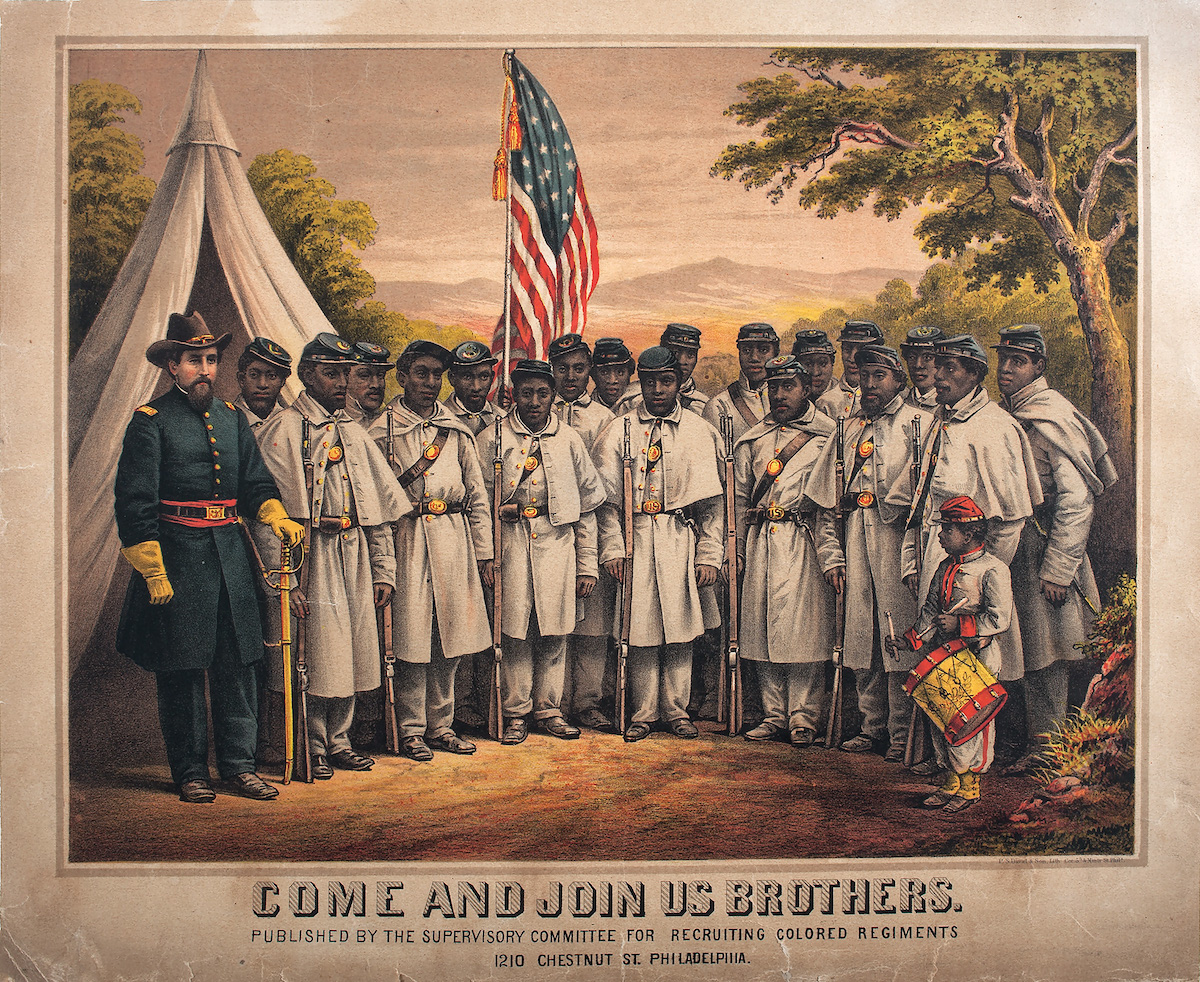
This Memorial Day, let us remember the 209,145 Black soldiers and White officers who fought as part of the Union Army of the American Civil War.
On Friday, Dr. Frank Smith was my radio show guest on “The Lyndia Grant Show” (Spirit 1340 WYCB, a Radio One Station), talking about the history of the project, and how the Spirit of Freedom Memorial is celebrated each year on the Sunday before the Memorial Day holiday, when hundreds of Black motorcycle riders called Rolling Thunder show up for a short ceremony. They come from across the nation, and the African American Civil War Memorial at Vermont Avenue and U Street in northwest Washington is an annual stop for Black Motorcycle riders, and they have been coming now for more than 10. This year the date of the Rolling Thunder celebration is Sunday, May 26, beginning at 10 a.m. The public is invited to attend.
Dr. Smith announced on my show that Rolling Thunder also gives a donation to the African American Civil War Memorial each year as well.
On another note, on July 18, this monument will celebrate its 26th anniversary. Unveiled on a hot, clear day, on July 18, 1998, with a crowd of more than 30,000 visitors from around the world who came to see the unveiling ceremony of the Civil War Memorial, erected for the United States Colored Troops. Descendant families attended, each wearing T-shirts with pride, bearing the name and regiment of the soldier who fought in the war which saved the Union, from their particular family. Media spoke with many families and wrote stories In newspapers across the country bought the plight of various soldiers. In fact, the granddaughter and great grandson of Frederick Douglass, along with other family members were here for the unveiling. His name is Kevin Douglass-Greene.
Appointed by D.C. Councilman Frank Smith to serve as project director, the unveiling celebration was planned under my leadership. I, Lyndia Grant, worked with more than 200 volunteers. Media coordination was part of my job, until the end, when the unveiling date approached, we hired a full-time press coordinator, my dear friend and colleague, Lavonia Perryman Fairfax.
The press came from far and near! On unveiling day, every major network had TV cameras parked around this Memorial. Our architect Paul Devrouax (now deceased) was on a major news station during the morning news. Dr. Frank Smith, our founder, was on another channel; Rev. Reginald Green, board secretary was on; and our board chair, Beverly Perry, then-senior vice president of Pepco, was on the morning news too.
I never will forget when Fox Morning News called to have a representative on their morning news, I contacted Dr. Smith to ask him who did he want to go. He said, “Lyndia, you got all of our key players on various news channels, you, will have to go on Fox Morning News. You’re the project director.” So, I did!
For those of you who are not familiar with the history of the American Civil War, and how the U.S. Colored Troops officially became members of the Union Army, here is what happened. The United States War Department issued General Order 143 on May 22, 1863, which authorized the establishment of the U.S. Colored Troops. The order also established a bureau in the Adjutant General’s Office to record matters relating to the organization of the troops.
The War Department issued General Order 143 on May 22, 1863, creating the United States Colored Troops. By the end of the Civil War, roughly 179,000 Black men (10% of the Union Army) served as soldiers in the U.S. Army, and another 19,000 served in the Navy. The new official number today is 209,145 United States Colored Troops, confirmed by the National Park Services and the National Archives and Records.
Here is a short history of the United States Colored Troops, this Memorial Day holiday weekend. These records were taken from the National Archives and Records. “The issues of emancipation and military service were intertwined from the onset of the Civil War. News that the Confederacy had attacked the U.S. garrison at Fort Sumter in Charleston, South Carolina — which began the Civil War in earnest — set off a rush by free Black men to enlist in U.S. military units. They were turned away, however, because a 1792 federal law barred them from bearing arms for the U.S. Army. In Boston, disappointed would-be volunteers met and passed a resolution requesting that the government modify its laws to permit their enlistment.
President Lincoln’s administration wrestled with the idea of authorizing the recruitment of Black troops, but was concerned that such a move would prompt the border states to secede. When Gen. John C. Frémont in Missouri and Gen. David Hunter in South Carolina issued proclamations that emancipated enslaved people in their military regions and permitted them to enlist, their superiors sternly revoked their orders. By mid-1862, however, the government was pushed into reconsidering the ban because of the escalating number of formerly enslaved people coming over Union lines (referred to in the military as “contrabands”), the declining number of white volunteers, and the pressing personnel needs of the Union Army.
As a result, on July 17, 1862, Congress passed the Second Confiscation and Militia Act, freeing enslaved people whose enslavers were in the Confederate Army. Two days later, slavery was abolished in the territories of the United States; and on July 22, 1862, President Lincoln presented the preliminary draft of the Emancipation Proclamation to his Cabinet.
After the Union Army turned back Confederate Gen. Robert E. Lee’s first invasion of the North at Antietam, Maryland, and the Emancipation Proclamation was subsequently announced, Black recruitment was pursued in earnest. Volunteers from South Carolina, Tennessee, and Massachusetts filled the first authorized Black regiments. Recruitment was slow until Black leaders such as Frederick Douglass encouraged Black men to become soldiers to ensure eventual full citizenship. (Two of Douglass’s own sons contributed to the war effort.) Volunteers began to respond; and in May 1863, the government established the Bureau of Colored Troops to manage the burgeoning numbers of Black soldiers.
Nearly 40,000 Black soldiers died over the course of the war — 30,000 of infection or disease. Black soldiers served in artillery and infantry and performed all non-combat support functions that sustain an army as well. Black carpenters, chaplains, cooks, guards, laborers, nurses, scouts, spies, steamboat pilots, surgeons and teamsters also contributed to the war cause. There were nearly 80 Black commissioned officers. Black women who could not formally join the Army nonetheless served as nurses, spies and scouts, the most famous being Harriet Tubman, who scouted for the 2nd South Carolina Volunteers.
Lyndia Grant is a speaker/writer living in the D.C. area. Her radio show, “Think on These Things,” airs Fridays at 6 p.m. on 1340 AM (WYCB), a Radio One station. To reach Grant, visit her website, www.lyndiagrant.com, email lyndiagrantshowdc@gmail.com or call 240-602-6295. Follow her on Twitter @LyndiaGrant and on Facebook.
