

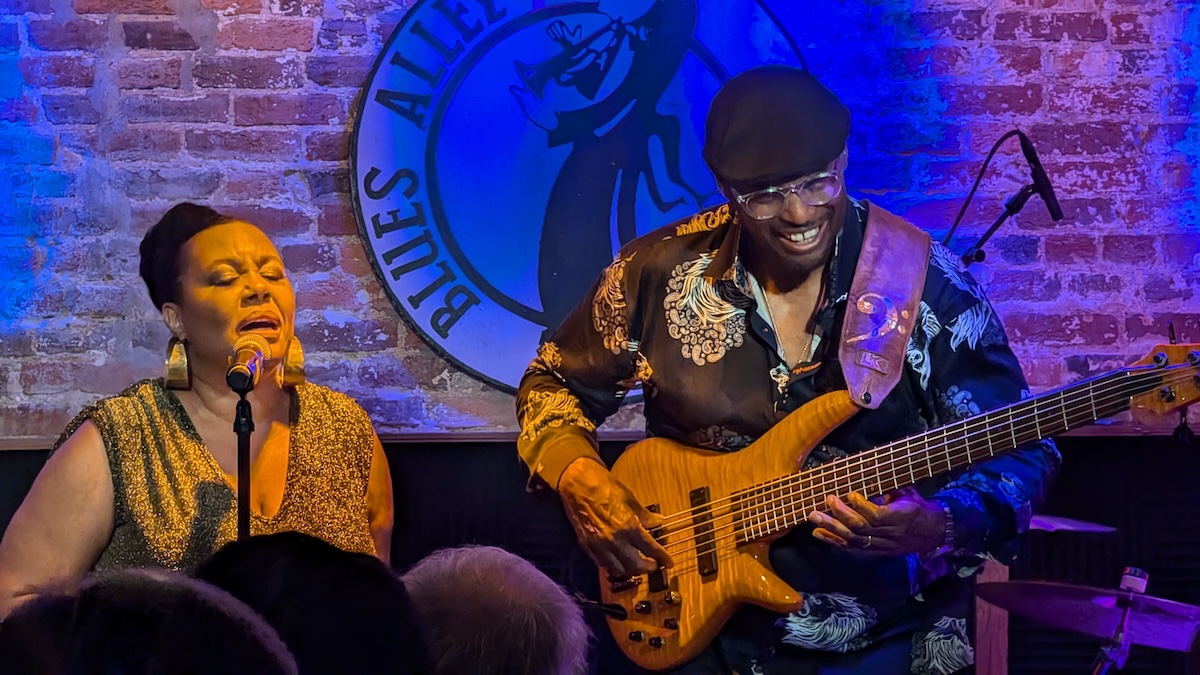
Blues Alley presented a two-night tribute to an iconic American music artist with “I Got Life: The Music of Nina Simone.” Opening with “I Wish I Knew How it Would Feel to Be Free,” it was an evening of well-known music from Simone’s songbook.
The show opened with bassist Gerald Veasley, pianist Aaron Graves and drummer James “Biscuit” Rouse performing an instrumental version of the celebrated classic song, written as an instrumental by Dr. Billy Taylor, musician, composer, and artistic director for jazz at the Kennedy Center, and a National Endowment for the Arts Jazz Master. Opening with Taylor’s masterpiece immediately told audiences there is an important message to be shared.
Multi-octave vocalist Carol Riddick then joined the trio for an entertaining set of classic Simone.
From “Ain’t Got No, I Got Life,” to “I Put a Spell on You,” to “Sinner Man,” to “Strange Fruit,” and everything in between, this journey through Simone’s repertoire was a delightful mix of music.
Bandleader Veasley gave a rundown of what to expect in four parts: “Quest,” where Simone searches for her identity; “Passion,” filled with love songs; “Social Justice,” where there is fury; and ending with “Hope,” which is self-explanatory.
“You’re going to be full of emotion that you are going to need a release,” Veasley explained with what the ‘Hope’ segment would provide.
Hearing and Visualizing Nina Simone
The unique arrangements of Simone’s classics made this tribute truly engaging.
Philadelphia-based vocalist Riddick did not attempt to mimic Simone’s distinctive voice. Instead, she applied a new spin with soulful and meaningful intent.
The tempo for “Here Comes the Sun” was jazzy, mid-tempo, and full, with Veasley and bandmates adding their special blend to the familiar tune.
A haunting interpretation of “Strange Fruit” put Riddick through a deeply emotional ride everyone felt.
Riddick said that when invited to be part of the production, she really needed to study to fully interpret the legendary singer’s body of work, however, she knew the emotions behind the tunes well.
“I can identify with some of her pains as an artist, a woman, and a Black woman,” said Riddick. “I can still identify with her frustration, with her trying to navigate a system not built for women. The pain is not old.”
The evening wrapped up with “To Be Young, Gifted and Black,” a song Veasley said he would play at the end of every school year for his daughter, from preschool through college and law school.
Veasley said he offers that same kind of encouragement to his work off the stage.
“I was just selected to chair the Greater Philadelphia Cultural Alliance,” Veasley proudly announced. “It serves over 400 members from museums, dance, and theaters. I love doing that kind of work.”
