

Seven decades ago, a 45-year-old Thurgood Marshall, then chief counsel for the NAACP’s Legal Defense Fund, led a determined group of attorneys to a victory in the Supreme Court of the United States (SCOTUS), marking the end of legalized racial segregation in American schools. The landmark decision in Brown v. Board of Education on May 17, 1954, not only integrated schools, but overruled the “separate but equal” principle set forth in the 1896 Plessy v. Ferguson case.
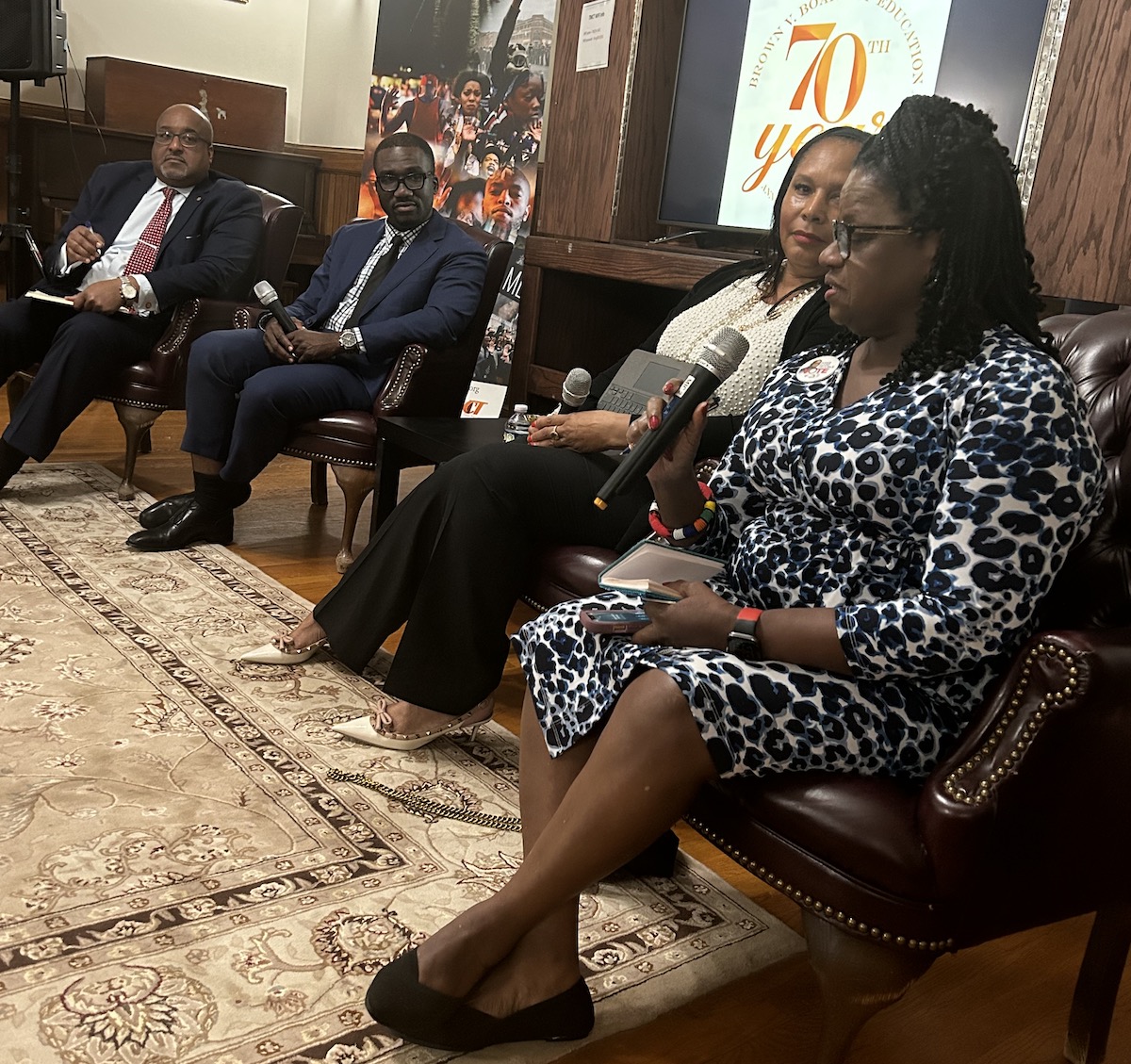
With Brown v. Board of Education turning 70 this year, the Thurgood Marshall Center for Service and Heritage (TMCT) in Northwest, D.C., honored the institution’s namesake with a thought-provoking panel pondering progress and the notion of “separate but equal” today.
“I was just starting school 70 years ago in the North Carolina Colored School System when Brown v. Board became the law of the land,” said TMCT Board Chair Dr. Benjamin F. Chavis, during the panel on Thursday, May 9.
As one of the panelists, Chavis remembered his childhood growing up in Oxford, North Carolina, where government officials employed numerous strategies to maintain the status quo and sidestep the unanimous 1954 SCOTUS decision.
“Things didn’t change – at least for me,” said Chavis, who also serves as president and CEO of the National Newspaper Publishers Association (NNPA). “I graduated from high school while forced to remain a student in a segregated school system.”
The powerhouse panel included: Chavis; Kim Keenan, former NAACP general counsel; Dr. Jean Accius, president and CEO of Creating Healthier Communities; Rawle Andrews, executive director of the American Psychiatric Association Foundation and the 135th president of the Bar Association of D.C.; and talk show host, Barbara Arnwine, president and founder of the Transformative Justice Coalition. Ebony McMorris, White House correspondent for American Urban Radio Network, moderated the informative discussion.
The panelist provided a reminder of the critical role that the judicial system has played in securing equal rights for African Americans – not only in public education but in all aspects of U.S. society.
With the 2023 SCOTUS decision overturning affirmative action, and the Court’s current conservative majority, panelists and guests considered where the nation is today.
“I think with this Court’s majority, especially with the decision last year on affirmative action… I definitely see the dissenting justices pushing back and not giving an accurate reading of Brown,” said Jenna Tomasello, a Buffalo, New York, native who has lived in the District for a decade. “Over the past 70 years, the Court has chipped away at Brown and at cases that came after that victory.”
After taking in the panel, Tomasello, 32, told The Informer the U.S. still has a lot of work to do to push toward true integration.
“We have always struggled to truly integrate our schools but as one panelist said, we have the system that we designed,” she said. “I believe we still lack the public and political will to fully implement Brown, paired with decades of laws and policies that prevent the true integration of public schools.”
Remembering D.C.’s Bolling v. Sharpe
The Court’s unanimous decision in Brown v. Board of Education was bundled with four related cases. One of the companion cases, Bolling v. Sharpe, changed the course of history for the nation’s capital.
Decided on the same day as Brown v. Board of Education, Bolling v. Sharpe stemmed from the D.C. Board of Education denying a petition by a group of parents in the, then, predominantly white neighborhood of Anacostia, to integrate John Philip Sousa Junior High School. As D.C. is not a state, the Supreme Court rendered a separate decision on Bolling v. Sharpe, ruling “separate but equal,” unconstitutional in District schools.
Today, Bolling v. Sharpe continues to reverberate in District neighborhoods and schools.
According to Statistical Atlas, African Americans currently account for 96.8% of Anacostia residents, in comparison to the predominantly white population in 1954.
Further, African American students are the largest population in District of Columbia Public Schools (DCPS), accounting for 56.9%, U.S. News reported.
During the 2022-23 school year, Sousa Middle School— where Black parents fought for the right for their children to attend more than 70 years ago— DCPS reported the student body as 94% African American and 6% Hispanic or Latino. Almost 70 years later, the once all-white school, reported no white students.
The panel ignited a particular flame in entrepreneur, philanthropist and former U.S. Senate candidate for the state of Maryland Dr. Roussan Etienne Jr.
“Listening to the panel talk about Bolling v. Sharpe reminded me of the importance of going back, doing the research and discovering or uncovering the truth that has long been hidden from view,” Etienne, 55, told The Informer.
A Northeast, D.C. resident, Etienne emphasized that knowing District history is particularly important as the nation’s capital still works toward equity, justice and freedom.
“We have a unique situation in D.C. Once, when we were known as Chocolate City, it was the Black intelligentsia who maintained order. Politicians, philanthropists, businessmen, educators – they ran this town. By design, we were used by others to strategically oppress our own kind,” he explained. “We’ve got to demand statehood and take control of our own lives and destinies.
