

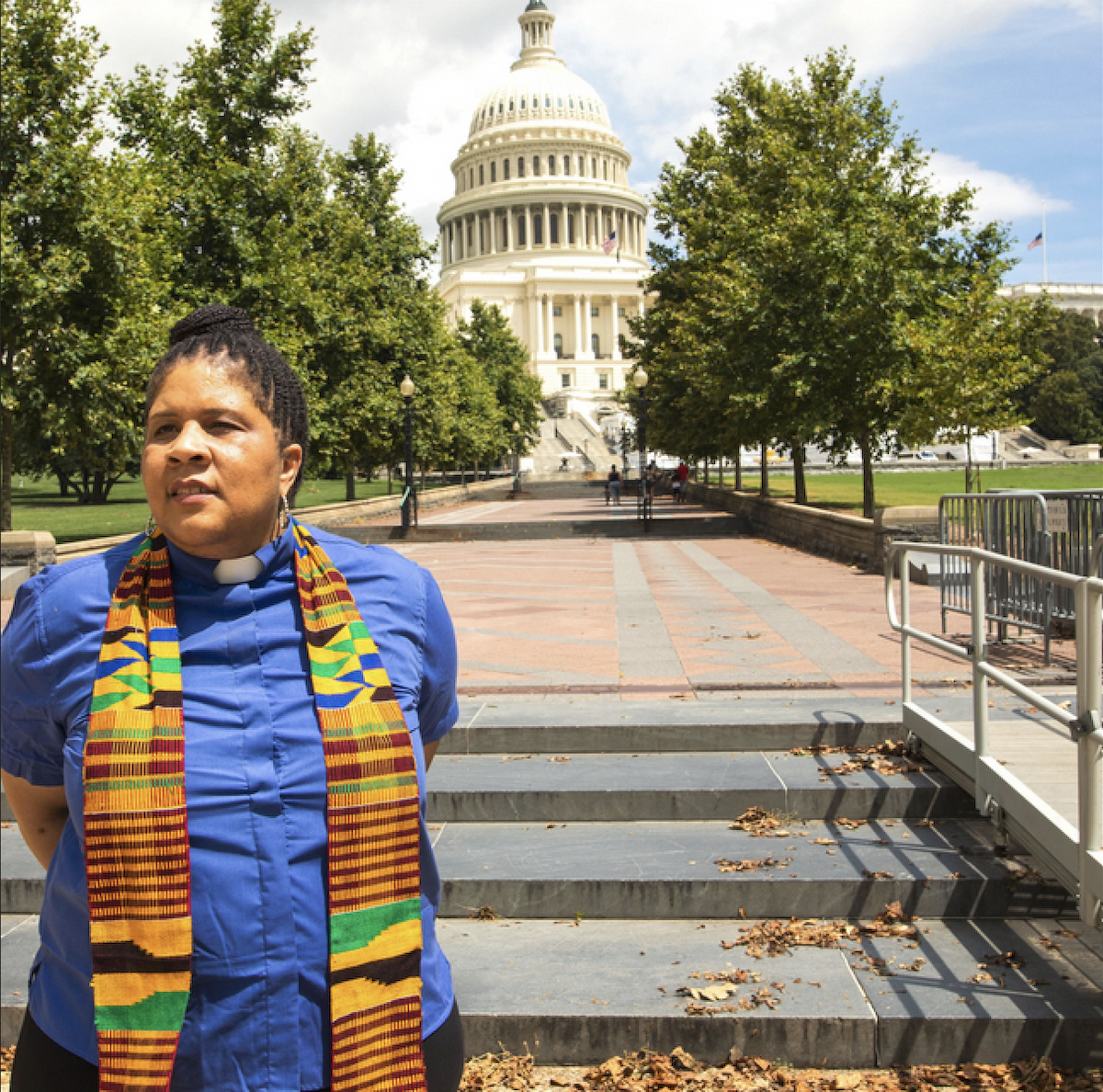
Throughout much of this year, the Rev. Wendy Hamilton has counted among the legions of D.C. residents who’ve taken to the streets in opposition to House Republicans’ infringement upon District of Columbia Council-approved laws and D.C. home rule.
For Hamilton, the situation on Capitol Hill further highlights the need for D.C. statehood, a crusade she says hasn’t been inclusive of all District residents.
That’s why, in her candidacy for the D.C. shadow senator seat, Hamilton pledges to rally District residents of various racial, ethnic, geographic and economic backgrounds around statehood and help them understand how it connects to the local issues that concern them the most.
“There’s more education around statehood that needs to be done to inform people and convince them to get on board,” said Hamilton, a #HandsOffDC Coalition member who currently serves as an advisory neighborhood commissioner in Ward 8’s Bellevue neighborhood.
“They have to [understand] how that benefits them in their daily lives,” continued Hamilton, a one-time candidate for D.C. delegate. “That’s a piece of the shadow senator role. You need to be in the city building relationships and talking to residents. I’m motivated to run and I feel like I can fulfill that role.”
Hamilton announced her candidacy for D.C. shadow senator in August, not long before Reps. Andy Ogles (D-Tennessee – 5th District), Matt Rosendale (R-Montana – 2nd District) and Byron Donalds (R-Florida – 19th District) introduced a bill to repeal the D.C. Home Rule Act, a 1973 law that expanded District autonomy.
Since then, she has conducted education sessions about the role of a D.C. shadow senator — an unpaid official who advocates for full statehood. During these sessions, some of which have taken place in Wards 1 and 8, Hamilton paints recent events on Capitol Hill in the context of public safety and other issues that have dominated conversations in the local arena.
Even though laws passed in the District have to go through congressional review, the Home Rule Act established the mayor’s office and 13 D.C. Council seats, all of which are elected by District residents. In recent months, both of these organs of local government have received the ire of congressional Republicans who’ve zeroed in on local laws and D.C.’s budget.
The #HandsOffDC Coalition, composed of 50 local and national organizations, has rebuffed such congressional challenges. Earlier this year, Hamilton spoke before #HandsOffDC organizers at rallies, and even joined them in engaging staff members in Rep. James Comer’s office about Comer’s resolution that successfully struck down Revised Criminal Code Act (RCCA).
As of late, Hamilton has even had choice words for Michael Brown, D.C.’s current shadow senator, whom she’s challenging in the upcoming election.
Earlier this year, Brown, not to be confused with former D.C. Council member Michael Brown, said that the D.C. Council, not congressional Republicans, threatened the viability of the statehood movement with left-leaning legislation, including that which allows noncitizens to vote. Weeks later, he invited Council member Vincent Gray’s staffer Chuck Thies, State Board of Education Representative Eric Goulet (Ward 3), and D.C. Police Union Chairman Gregg Pemberton — all outspoken critics of the council — on his “Shadow Politics” program.
Hamilton told The Informer that Brown has set back statehood efforts — and betrayed his obligations to this office — by parroting House Republican talking points.
“If you didn’t agree with the council, that’s fine, but you don’t side with Republicans and conservatives trying to override the will of the people,” Hamilton said. “That’s the statehood fight and your one job. We need to be on the same page. Michael Brown didn’t sound like a stalwart champion for statehood that we need in this moment of concentrated attacks by House Republicans.”
Other candidates in the D.C. shadow senator race are Brandaun Dean, a D.C. politico who made history as the youngest elected mayor of an Alabama city, and Andrew Haynesworth, a former D.C. teacher. On Sept. 28, Ankit Jain, a member of the Make All Votes Count DC campaign leadership team, threw his hat in the ring.
Brown, in office since 2007, has not officially registered with the Office of Campaign Finance for reelection.
At the beginning of the year, D.C. Delegate Eleanor Holmes Norton (D) introduced the Washington D.C. Admission Act, which would make D.C. the 51st state. With that designation comes full voting representation in Congress and state-level self-governance. The House passed the bill in 2020 and 2021. Meanwhile, on the Senate side, Sen. Tom Carper (D-Delaware) galvanized his fellow Democrats by introducing a similar bill.
If the House and Senate approve D.C. statehood, then D.C. would enter the union as Washington, Douglas Commonwealth, a name approved in a 2016 ballot measure that also adopted a newly written District constitution and designated boundaries for what would be a new state.
Throughout contemporary efforts to secure statehood, however, Republicans have been a consistent roadblock. In 2020, Senate Republicans didn’t consider Norton’s statehood bill after it passed the House. With a majority in both legislative chambers, Republicans have only ramped up their efforts.
Before successfully striking down the RCCA in March, House Republicans kept constituents befuddled about the legislation and its impact. That strategy compelled President Joe Biden (D) to sign the resolution into law once it passed through both chambers. Weeks later, the House Committee on Oversight and Accountability conducted a hearing focused on statehood and public safety that placed D.C. Council Chair Phil Mendelson (D) and Council member Charles Allen (D-Ward 6) in the hot seat.
In July, the House Appropriations Committee introduced a government spending bill aimed at cutting funding for the presidential motorcade and banning the use of traffic cameras. Local officials estimated the projected loss of revenue at $1 billion over four years. The bill also prohibited the District from taxing and regulating medical cannabis and using local funds for abortions while preventing the Police Reform Act from taking effect.
Deliberations around the RFK campus, once again, highlighted the District’s tenuous relationship with Congress on Sept. 20 when Rep. Scott Perry (R-Pennsylvania 10th District) unsuccessfully introduced an amendment barring the appropriation of federal funds for the development of a new stadium.
Amid the friction between D.C. government officials and congressional Republicans, some people like Lisa Gore, said that District residents need further encouragement and education about the power of statehood.
Gore, an advisory neighborhood commissioner in the Hawthorne/Chevy Chase community of Northwest and Hamilton’s campaign co-chair, said that Hamilton has the energy and experience necessary to breathe new life into the shadow senator role.
In 2022, Gore met Hamilton while campaigning for the At-large D.C. Council seat. At the time, Hamilton was running against Norton. Gore said she and Hamilton connected around their Zeta Phi Beta affiliation and what she described as a common mission. In speaking about Hamilton, Gore said that Hamilton’s experience as a mother, grandmother, advisory neighborhood commissioner and grassroots statehood proponent places her in the perfect position to interact with politicians and residents of various political backgrounds.
“As a District, we don’t have a robust educational campaign and people feel disillusioned by the meddlesomeness of Congress,” Gore said. “That’s why it’s so important to have someone [like Rev. Hamilton] in the seat who has that energy and continues to push and fight forward. That means showing up in community and helping people understand that everyday problems can be solved by statehood, and reminding them that we need to continue to fight for that cause.”
