

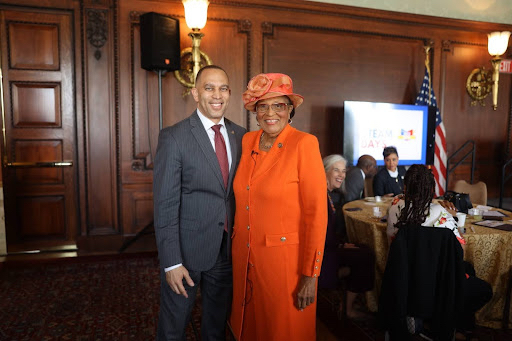
For the sixth year in a row, Democratic Rep. Alma Adams (D-NC) engaged House members from both sides of the aisle to invest in historically Black colleges and universities (HBCUs) and empower students to pursue science, technology, engineering, arts and math (STEAM) education. “HBCU STEAM Days of Action,” a two-day event, not only encouraged bipartisan support for HBCUs, but emphasized the importance of these historic institutions in building future world leaders.
“HBCUs produce over a quarter of African American STEM/STEAM graduates in the United States, and it has never been more important to make sure every talented student has access to a world-class science, technology, engineering, arts, and math education,” said Adams, founder and chair of the Congressional HBCU Caucus.
According to the Congresswoman’s office, HBCUs produce 27% of all African-American STEM graduates and 40% of all African-American engineers. The North Carolina representative emphasized the importance of HBCU STEAM Days of Action in promoting equitable access to federal funds.
“It’s a time when HBCUs come to Capitol Hill to advocate for more equitable federal resources – and they don’t come alone,” she continued. “They are joined by industry leaders who have made a commitment to creating strategic and sustainable partnerships with HBCUs.”
The annual event included educational conversations with Janet McCabe, deputy administrator of the Environmental Protection Agency (EPA), Cindy Marten, U.S. Department of Education deputy secretary, and Rep. Suzanne Bonamici (D-Ore.), Congressional STEAM Caucus chair.
McCabe spoke passionately about the EPA’s Clean School Bus Program that provides grants to institutions looking to cut carbon emissions by using electric vehicles for student transportation.
She mentioned that although the initiative is geared towards K-12 schools, others are welcome and encouraged to apply.
“Our administrator has always got his eyes out for HBCUs that are interested in partnering,” she shared. “I would encourage you to make sure that you know the person at your EPA regional office; their job is to be connected to the MSIs (minority serving institutions) in their region. If there was an HBCU interested in converting their fleet from diesel to electric, there are a wide variety of funds available to them.”
McCabe presented to more than 70 HBCU representatives, including Dennis Shields, president of Southern University, Helene Gayle, president of Spelman College and Hacene Boukari, a professor of physics at Delaware State University– representing three schools with the same vested interest.
Each school is working to obtain R1 status, a term used by the Carnegie Foundation to categorize doctoral granting universities with the highest performance in key areas associated with Research and Development (R&D).
“A lot of HBCUs are in a race to be an R1 institution and we have a lot of work to do. But it’s nice to hear what the Department of Education deputy secretary and EPA deputy secretary are saying,” said Boukari.
Currently, no HBCU has qualified for the R1 category. But that’s a mission Adams, Marten and other government agencies are working to change.
Marten said when she first began working for the Department of Education, the agency understood the importance of equitable access to STEM education and resources.
“It needed to be about investment in the STEM teacher pipeline to make sure we had a more diverse STEM teaching workforce to invest in classroom experiences, training and development for teachers,” said Marten.
Despite efforts to encourage young learners to advance science, technology, engineering and mathematics skills, such as the Department of Education’s YOU Belong in STEM national effort, equity in STEM education nationwide remains a challenge.
Last year, the Department of Education announced that $5 million would be allocated to Hampton University, Southern University, University of Maryland Eastern Shore and Tennessee State University to improve the schools’ research facilities and infrastructure.
“We have made a lot of progress with research centers funded by federal agencies, but I think there is more to do. We are not getting our fair share amount and I appreciate that the representatives present acknowledged that,” Boukari told The Informer.
Adams taught more than four decades at North Carolina A&T, the nation’s largest public HBCU. While her discipline was focused on the arts, the congresswoman shared that funding secured by an institution can benefit the entire college’s community.
“When equipped with a STEAM education from an HBCU, the sky is the limit for our students,” Adams said.
