

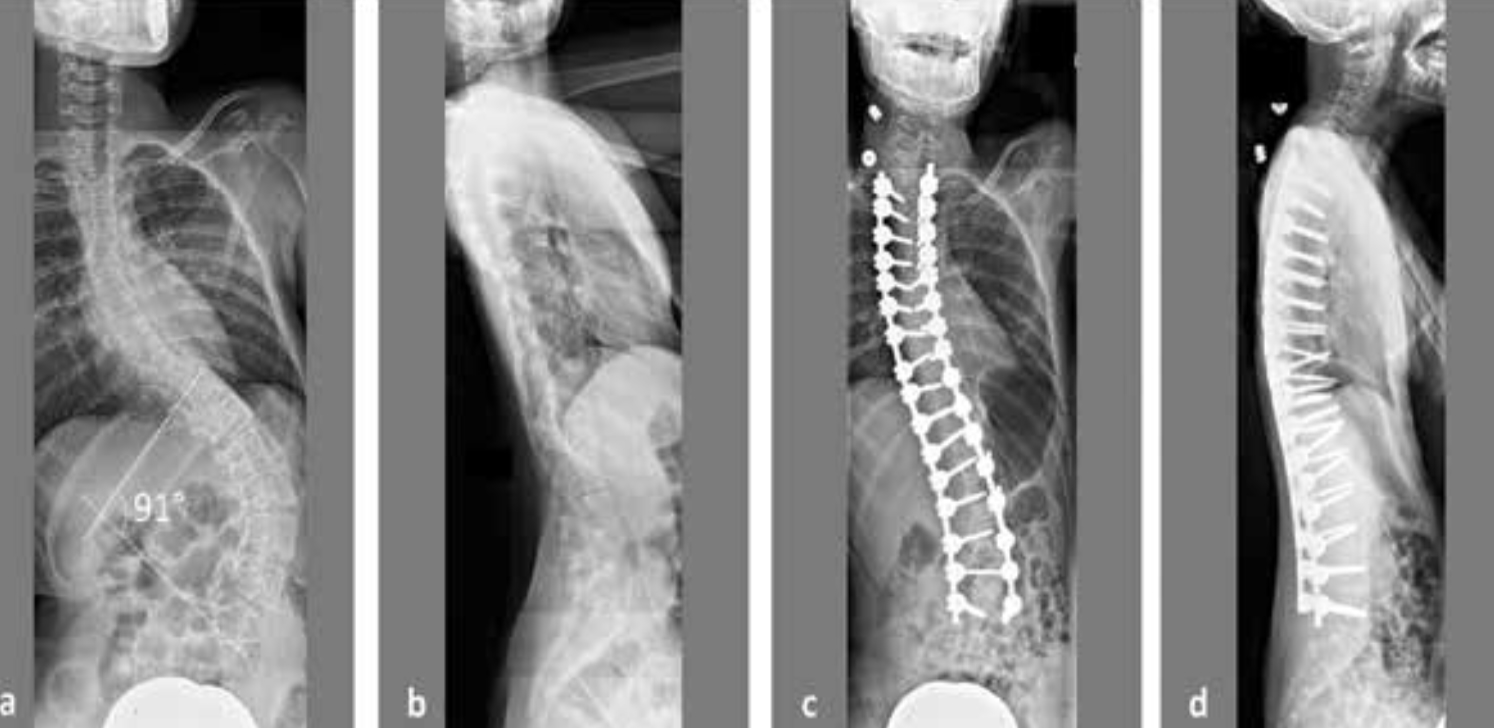
Scoliosis, an often hereditary spinal condition that can develop in infancy or early childhood, is an abnormal lateral curvature of the spine causing an irregular S-or C-shaped curve, that can cause discomfort and challenges, and may require treatment.
Scoliosis affects 2-3% of the population accounting for roughly six to nine million people across the United States, with “the primary age of onset for scoliosis is 10-15 years old, occurring equally among both genders,” according to the American Association of Neurological Surgeons.
Luke Stikeleather, founder, president, and chief orthotist with the National Scoliosis Center, works with a plethora of children facing scoliosis at both his Baltimore and Fairfax County office locations.
As an orthotist, Stikeleather is trained in fitting and creating braces and splints. He spoke with The Washington Informer to share expert facts about scoliosis and clarify any misconceptions.
Did You Know the Numerous Classifications of Scoliosis?
“We can classify scoliosis into several different categories of types or subtypes. The typical type that affects the largest population is idiopathic scoliosis – the root word of that means, ‘without larger unknown.’ Even though that has historically been the term, we now know more than ever that this is a genetic component that is often seen in family members and relationally passed down.
There’s also syndromic scoliosis that is going along with genetic deletions and some of the other things that have been found in other medical conditions.
There’s neuromuscular scoliosis, common to conditions like muscular dystrophy or cerebral palsy. There can even be traumatic scoliosis, where an injury has occurred.
Then there’s congenital scoliosis, where you’re born with an absolute defect in the bone structure of the spine that can cause a curve to be there at the point of birth and progress over time.”
We call it adolescent idiopathic, because it typically is more apparent as it gets bigger and that changes the shape of the torso. You see evidence of it in larger curves and smaller curves. So around [ages] 10/11, we start this last big growth spurt for girls. Around [ages] 12/13, it happens for boys, and so that’s why that’s the larger group of identification. But it does absolutely happen in younger children, too. And so, our population for treating it is anything from infants to 17/18, years old.
Did You Know the Varying Degrees of Scoliosis?
“Scoliosis can be a small curve. It can be a single curve, a double curve. It can be higher in the spine or lower in the spine. So it depends on the [individual] and how that person is growing.
It’s often driven by growth. So the occurrence is in about 3% of the population of that a small minority will end up having to have it treated. And we don’t treat curves, generally speaking, below 20 degrees, so there needs to be a size that the physician deems appropriate for bracing.”
Between 20 and 50 degrees is the range that’s often suggested for bracing. And above 50, surgeons start to talk about the need, potentially, for a surgical intervention for a fusion of the spine.”
So, identifying it is the first line of priority and defense, and if you can identify a small curve, treat a small curve, and keep it at those smaller values, then you’ve avoided a big problem in the future.”
Did You Know Parents and Physicians Can Help Detect Scoliosis Early?
“School screening used to be a common thing in every state, because they identified scoliosis as a significant condition that needed to be addressed. The sooner the better. Unfortunately, because there have been some differing views expressed about the cost of screening, it’s largely been eliminated in many places. So it’s often a state by state and a locality decision as to whether or not to have screening. Well, that puts a tremendous burden on the physician now to be the point for doing annual exams on children and looking for scoliosis, and that can also be a bit of a hit and miss proposition.
The third line of defense is parents, noticing asymmetrical differences in their children, their shoulder asymmetry, is one shoulder higher or lower, any lumps or bumps that they notice in the summer, in the bathing suit when at the beach or the pool, things [of that nature], and then take them to the pediatrician for an evaluation.
For parents, a good tool to do is to go online and look at scoliosis, YouTube videos about screening [and] identifying, because there are some tools and guidelines to look for.”
Read more on washingtoninformer.com.
So, the typical age range can be anywhere from infancy all the way up to 14/15 but typically you’re going to find a scoliosis in that range at some annual physical or parents as being the point of examining that.”
Did You Know the Effects of Spinal Curvatures?
“When curves aren’t treated, there are several possibilities [that can happen]. They may stay stable, they might not ever progress. [On the contrary], they may absolutely progress with growth, and that’s what often happens.
If they stay under a threshold of 50 degrees, they could live a long, happy, healthy life with no complications. As the curve increases, so does the actual change in shape of the rib cage, [and] of the torso with more noticeable for lack of better terms, we use the word deformity. You can absolutely see chest wall changes, structural changes that become more aesthetically unpleasing, cosmetically apparent. So, from that standpoint, you can have large curves and have no complications.”
We know of kids who have 60 and 70 degree curves that don’t have pain, that don’t have physical limitations, that have chosen of their own accord not to have surgery. But inevitably, gravity has an impact on all of us, making a lot of us get shorter as we age, and can attack scoliosis, so that a curve can continue to progress through adulthood, at which point in time we may, out of necessity, end up with large curves and needing to have surgery for that.”
Did You Know We Can Maintain Our Spinal Health At Home?
“There are some specialized exercises that can be synergistic with the bracing process, but the brace is the number one mechanism because it’s absolutely pushing in the right places to mechanically move the spine and to allow the patient to grow within that directionality of the brace to improve it.
And so, the key to getting improvement usually, is growth. Number one, good wear time, over 20 hours a day, which sounds terrible, but most patients adapt to it and can do it with ease.
There are specialized exercises that you would definitely need to connect with a physical therapist for, who has been trained in how to teach you to do that, and then you do that on your own at home.”
Did You Know People Can Thrive Despite Scoliois Challenges?
“Having scoliosis doesn’t mean your life changes dramatically just because you have it, and so if [you don’t have a] brace, let’s say you have a curve that’s small, it doesn’t impact your life [or have] much limitation at all. Do everything that anyone else does as people won’t even know you have it.
If you’re wearing a brace, you can go take the brace off at the nurse’s office and continue to participate in [physical education] or go out on the field for your activities during the day.
Even if you’re a competitive athlete, you’ll have time in the brace and time out of the brace so that you can do those activities. But there’s no reason that bracing has to be a major game changer, and we stop bracing when we reach skeletal maturity for girls around age 15, for boys, 16, 17, and 18.
So, once you’ve come somewhat of your adult height and size, you’re done with the brace and you don’t typically go back to it, unless you use it as a pain management tool for some of the adults.
There are people in every profession, there are people in every sport, who have scoliosis. Usain Bolt, was one of those guys in the pack team from Jamaica, and there are other famous actors and actresses that have scoliosis. So if you looked at the celebrity list, you’d see that there’s a good number of folks who have had great careers and great success who had scoliosis, so it doesn’t have to be something that really is an impairing fact.
The last point I’d make with that is, is that most of us grow most in the midst of adversity, and so when we face challenges in life, it often makes us stronger, and having to endure the challenge and the hardship of wearing a brace or having had surgery develops character and makes us able to handle other challenges that come our way.”
