

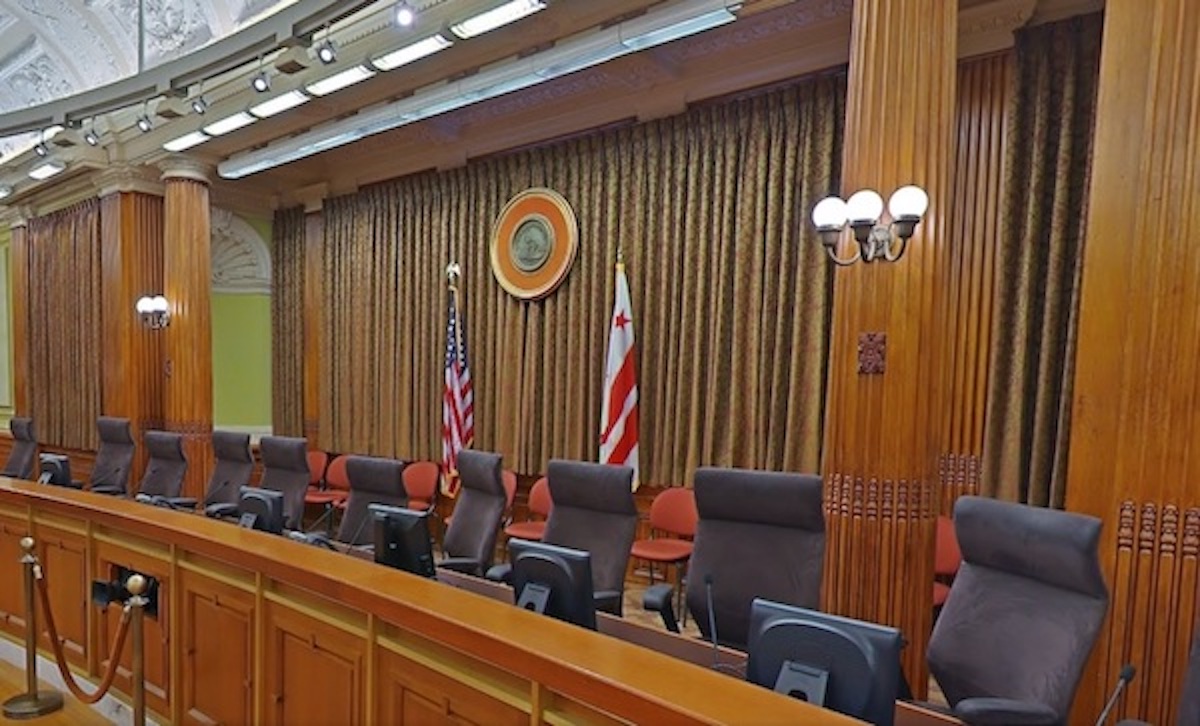
This edition of The Washington Informer Collins Council Report unpacks the council’s meeting with the D.C. Sentencing Commission and the Committee of the Whole hearing that took place after.
Legislation on the table included a bill that helps pregnant District students continue their education, a resolution for the confirmation of Acting Planning and Economic Development Deputy Mayor Nina Albert, and D.C. Council member Brooke Pinto’s Secure DC Omnibus bill.
Read this report for more information.
The Council Meets with the D.C. Sentencing Commission
The D.C. Council preceded its Jan. 23 Committee of the Whole meeting with a sit-down with the D.C. Sentencing Commission.
This meeting, coordinated amid discussions about Joel Caston’s nomination to the board, allowed Commission Executive Director Linden Fry and D.C. Superior Court associate judge and commission chair Milton C. Lee Jr. to break down the development of sentencing guidelines and weigh in on the discussion about the experience required of commission members.
Lee, in response to Council member Zachary Parker’s question on the matter, espoused the need for diverse viewpoints and experiences on the D.C. Sentencing Commission, especially as it related to community members who’ve been through the criminal justice system.
“They’re connected to the community and give us a good idea of what the community says about what we’re doing,” Lee said. “We’re blessed with folks with a nominal amount of experience. The value is a lot of information coming from a lot of places. I reject the notion that because you served time, you would work for shorter sentences.”
This portion of the discussion followed a presentation that Fry and Lee conducted about the sentencing guidelines. They stressed, particularly in their exchange with Council member Anita Bonds (D-At Large), that with the congressional takedown of the Revised Criminal Code Act, judges still have some latitude in how they impose sentences for various felonies.
Lee and Fry said that judges, in handing down sentences, take into consideration the severity of the offense and the defendant’s prior convictions. The duo also explained that judges, based on a defendant’s conviction history, can impose split sentencing where defendants serve up to six months behind bars and the rest of their time under supervised probation.
Fry pointed out that judges can make mitigating departures, where they impose sentences on the lower end of the sentencing guidelines spectrum in exchange for a defendant’s cooperation. He also said that judges, depending on the severity of a victim’s injuries, could go on the other end of the spectrum, a process called aggravating departure.
During the presentation, Fry said D.C.’s sentencing guide, now 20 years old as of this week, undergoes adjustments via vigorous debate between all 17 commission members — ability to vote notwithstanding.
Lee, speaking about the compilation of the sentencing guidelines, said that commission members execute “data-driven use of discretion.” That data, he said, comes from the D.C. Superior Court and, as of shortly before the pandemic, the Metropolitan Police Department.
That point elicited questions from Parker and Council members Matt Frumin (D-Ward 3) and Kenyan McDuffie (I-At Large) about whether the commission bends toward the will of judges in setting sentencing guidelines.
McDuffie followed up by asking whether the commission looked at how often, during plea deals, judges’ sentences aligned with either defense and prosecutor recommendations.
Fry pointed out that while the commission, in the process of setting guidelines, gleans data related to the frequency of sentences handed down, charges at the time of arrest, and the outcome of grand jury trials, commission members could benefit from a complete breakdown of defendants’ criminal history score, which comes from Court Services and Offender Supervision Agency (CSOSA).
Council member Brianne Nadeau (D-Ward 1) later questioned the efficacy of court supervision, as facilitated by CSOSA. Her inquiry preceded commentary by Council member Christina Henderson (I-At Large), who expressed some apprehension about split sentencing and how defendants are allowed to walk the streets after only a few months of incarceration.
In response to Nadeau, Lee designated CSOSA as “the folks on the front line. Council member Brooke Pinto (D-Ward 2), chairperson of the council’s Committee on the Judiciary and Public Safety, pointed out that emergency public safety legislation approved by the council last year mandates that public posting of information about CSOSA’s metrics of success in the arena of court supervision.
The Secure DC Omnibus Act, up before the council that afternoon, also addresses Nadeau’s concerns, Pinto went on to mention.
Council Member Henderson Focuses on Pregnant Schoolchildren in Legislation
When a female high school student becomes pregnant, her chances of graduating on time declines by 40 percentage points, according to the Centers for Disease Control and Prevention.
As part of an effort to address this phenomenon, Council member Christina Henderson (I-At Large) introduced the Extended Students’ Right to Home or Hospital Instruction last summer.
On Tuesday, the council unanimously approved a committee print of the legislation.
During a public hearing last November, no one spoke in opposition of the legislation, Council Chair Phil Mendelson (D) said on the dais.
The bill will now go before the Committee of the Whole during its early February legislative meeting. If passed, it will add preterm birth complications, childbirth and postpartum recovery to the list of health conditions for which students are eligible for home or hospital instruction via the Students’ Right to Home or Hospital Instruction Act.
The aforementioned legislation, passed in 2020, requires D.C. Public Schools and public charter schools, all of which are designated as local education agencies, to implement a home and hospital instruction program that supports students who’ve been absent from school for at least 10 consecutive days because of a health condition.
However, the law, as interpreted by the Office of the State Superintendent of Education, currently excludes students experiencing preterm birth complications, childbirth and postpartum recovery.
That’s why Henderson, speaking from the dais on Tuesday, celebrated the legislation’s advancement and what it could mean for a group of high school youths vying for some continuity in their academic pursuits.
“This legislation would dismantle the biases we have regarding health conditions and help students who find themselves in a situation where they need assistance,” Henderson said. “I look forward to getting this bill passed and ensuring all students whose health needs require accomodation[s] get those needs met.”
Nina Albert Confirmation, and a Question about the Kennedy Street Library
On Tuesday, Nina Albert, a native Washingtonian and longtime fixture in local and federal development space, inched a bit closer to her official installment as D.C. deputy mayor for planning and economic development (DMPED).
Without objection, the D.C. Council placed Albert’s confirmation resolution on the agenda for its Feb. 6 legislative meeting. Council member Kenyan McDuffie (I-At Large) didn’t mince words in speaking about the significance of Albert’s appointment.
“There are some pressing challenges for our local economy around a competitive post-pandemic environment, retaining existing businesses and attracting new large and small businesses, like grocery stores and retail across our city, especially in Wards 7 and 8,” McDuffie said. “For most of last year, DMPED was without a permanent leader so I look forward to working to make sure that the city’s most equitable days are ahead of it.”
Mayor Muriel Bowser (D) nominated Albert last year, touting her vast experience and expertise needed to usher D.C. into the next era. Earlier this month, McDuffie, chairperson of the council’s Committee on Business and Economic Development, conducted a public hearing on Albert’s nomination.
That hearing took place amid conversation about downtown development, particularly Gallery Place-Chinatown, the future of which is in question with the likely move of the Washington Wizards and Washington Capitals to northern Virginia.
In the days leading up to her hearing, Albert affirmed her focus on equity.
“Small and local businesses are critical and we have a commitment to government contracts and grants,” Albert said on Jan. 4. “We are setting the base. We know they create jobs and keep our city thriving. I encourage our businesses to look for that announcement. D.C. is a place to do business.”
In the weeks leading up to the council’s Feb. 6 legislative hearing, at least one council member will have a pressing question of Albert as it relates to equitable development.
Council member Janeese Lewis George (D-Ward 4) asked McDuffie whether he spoke to Albert about the construction of the D.C. public library branch along the Kennedy Street corridor in Northwest — the funds for which had already been allocated.
McDuffie said he reached out but heard nothing from Albert’s office. Shortly after, he told Lewis George that he would facilitate conversation between the two parties about the library.
The Secure D.C. Omnibus Bill Incites Vigorous Debate
The D.C. Council placed Council member Brooke Pinto’s Secure D.C. Omnibus Amendment Act on the agenda for its Feb. 6 hearing, but not without some questions and dialogue on the dais.
So much so, that this report touches only the surface of that conversation.
Council member Kenyan McDuffie (I-At Large) said he wanted to evaluate whether pretrial detention, which would be made permanent in the legislation, was effective. He also questioned the expansion of DNA collection and the reversal of police accountability measures, as outlined in the bill.
At-Large Council member White had questions about the effectiveness of drug-free zones, pointing out that selling and using drugs was already illegal. Council member Christina Henderson (I-At large) expressed similar concerns, asking Pinto if the Metropolitan Police Department thought about how to filter requests that target areas where substance use treatment centers exist.
Henderson, a judiciary and public safety committee member, also questioned the delay of a provision dealing with cashless transactions. Council member Brianne Nadeau (D-Ward 1) requested further study about the economic impact of that provision.
In his remarks, Council member Trayon White (D-Ward 8) questioned the constitutionality of drug-free zones and what he described as the exclusion of provisions that returning citizens suggested. Later, Council member Matt Frumin (D-Ward 3) asked how the lessening of neck restraints would affect police-resident interactions.
Council member Zachary Parker (D-Ward 5) said he thought Bowser struck the right balance in the original ACT Now legislation. He went on to request information about the number of FOIA requests that result in sustained allegations of police misconduct. He also had a question about enhancements included in the bill for the possession of firearms when stalking someone and the possession of firearms with scratched-off serial numbers.
In her remarks, Council member Anita Bonds (D-At Large), referring to a provision of the omnibus bill, warned against an oversaturation of returning citizens in culinary arts. She suggested that the council expands returning citizens’ access to other occupations.
Council member Janeese Lewis George (D-Ward 4) later asked for the timeline on a racial equity impact assessment, otherwise known as a REIA. Earlier in the discussion, she alluded to the increase in the D.C. Jail population caused by pretrial detention, as mandated in last summer’s emergency legislation. She also questioned why Pinto’s omnibus bill included further tweaks to a police pursuit provision.
Throughout the hourlong conversation, Pinto responded to her colleagues’ questions. Before doing so however, she gave an impassioned cry for the council’s embrace of the omnibus bill.
“D.C. residents cannot wait any longer to feel safe and secure. I have worked with all of you on this effort and this is an opportunity for the council to make an important step to move our city forward in a safer direction,” Pinto said.
“Our residents are asking us how we can play a role in building safer communities,” she continued. “The process we underwent is the right one. And the provisions are necessary steps taken as a whole to effectuate the improvements we need to make D.C. residents safer and more secure.”

Thanks, Sam!