

Your body is a temple… — 1st Corinthians 6:19-20
Let’s talk about the problem. This period in American history dates back to 1790, and for those enslaved ones, food was still scarce, thus the “thrifty genes” protected them. If you research the documentation found at the National Archives and Records Administration, slaves received rations in America.
Africans who managed to survive the slave trade here in America arrived on the shores very strong. The majority of them worked in fields from sunup to sundown, six days per week, and in many cases, seven days a week. Slaves ate what we call “soul food” scraps, like hog maws, chitterlings, pigtails, pig feet and pig ears, and they drank milk from a trough alongside other animals! No longer in their homeland, our people ate whatever was made available to them — scraps.
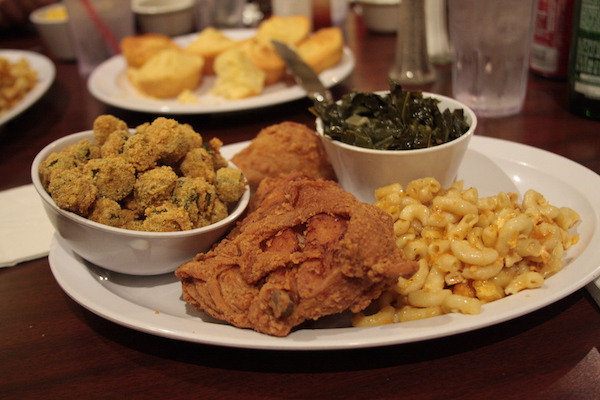
In an effort to create a delicious meal, the women worked at creating recipes they could all enjoy. They loved collard greens with fatback meat. They used lard and learned to bake sweet potato pies. They cleaned chitterlings and made them into a delicacy to be eaten on special occasions. Pots of beans seasoned with ham hocks, or pigtails, pig feet, and seasoned with pork — a harmful, but delicious tradition that still lives on today. Homemade biscuits from self-rising flour were the norm, made from white flour and lard. They learned to make hush puppies, candied yams, peach and apple cobblers, pies and cakes, all types of potatoes, cornbread, and the soul food list goes on and on.
Though the enslaved ate poorly, they enjoyed it and were able to sustain themselves easily. Why? They didn’t realize it at the time, but due to the physical labor in the fields 12-16 hours a day, from sunup to sundown, the diet did not harm the slaves. The exercise burned off all negative possibilities. Compare our lifestyles today to that of the slaves — you will see what has happened.
This, according to NIH, work was the difference. 12-16 hours each day of physical labor, that’s a lot of time exercising! Plus, they had the so-called “thrifty genes,” which allowed their bodies to preserve food in an appropriate manner when food was scarce.
What is the major cause of Type 2 diabetes in the United States? Research shows that being overweight or obese and physical inactivity are the main culprits. Extra weight sometimes causes insulin resistance and is common in people with Type 2 diabetes. The location of body fat also makes a difference.
In general, obesity was a stronger independent risk factor than physical inactivity for Type 2 diabetes. Some studies concluded that the risk of physical inactivity differed between categories of BMI. It was suggested that increased physical activity may, at least in part, counteract the detrimental effects of obesity.
Pay close attention to your activity level, the number of steps you take in 24 hours, and definitely pay close attention to the foods you buy and eat. Google to find answers about non-organic foods and see for yourselves. I have found quite an abundance of information on how there are many synthetic chemicals that have infiltrated our food system during the period in which rates of diabetes have surged.
Data has suggested that one particular synthetic chemical, bisphenol A (BPA), may be associated with an increased risk of developing Type 2 diabetes (more about this in my next column).
Many chemicals are tough to avoid. But you can limit your exposure to chemicals added to food intentionally, especially some artificial sweeteners, preservatives and added sugars such as high-fructose corn syrup. Read the labels! Sugar comes in different names. If you set a goal to pay closer attention to what you eat in 2024, and you want to know how to reduce your exposure to harmful chemicals as shown by the following research by numerous research studies, then follow these proven guidelines.
Lyndia Grant is a speaker/writer living in the D.C. area. Her radio show, “Think on These Things,” airs Fridays at 6 p.m. on 1340 AM (WYCB), a Radio One station. To reach Grant, visit her website, www.lyndiagrant.com, email lyndiagrantshowdc@gmail.com or call 240-602-6295. Follow her on Twitter @LyndiaGrant and on Facebook.
