

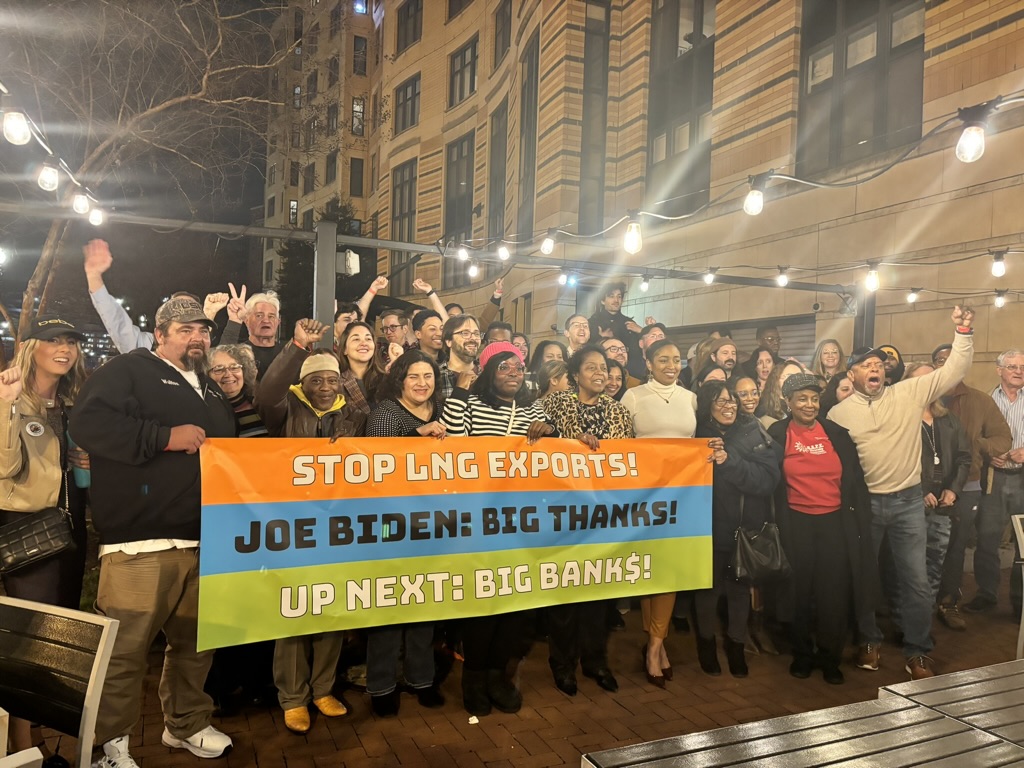
Environmental activists from across the country gathered in D.C. on Jan. 31 to celebrate President Joe Biden’s recent decision to pause approvals for new liquefied natural gas (LNG) export facilities. At a party hosted by Fossil Free Media, advocates on the front lines of LNG-related pollution in Louisiana marked the victory of a targeted campaign while gearing up for the next fight.
Roishetta Ozane, founder of the environmental justice group Vessel Project of Louisiana, said in a speech at the #StopLNG party that the next target for the movement would be national and international banks’ investments in fossil fuel industries.
“The work does not stop — we can only celebrate for a few seconds, and then we must continue to work,” Ozane emphasized. “So, the next step in what we are doing is we’re calling out the big banks. So, Joe Biden, thanks; up next, big banks.”
The Biden administration announced the LNG export pause on Jan. 26, saying that the Department of Energy would use the time to update the economic and environmental analyses that determine whether an application is authorized. Advocates have pointed out that the agency has never rejected a gas export application on the grounds of harm to the public interest, despite the pollution risks such operations can pose to surrounding communities and ecosystems.
“We have been begging for the Department of Energy to look at this public interest determination for years,” said James Hiatt, a climate resilience specialist representing For A Better Bayou.
In response to Biden’s action to put a pause on all new LNG exports, Hiatt expressed a desire to keep pushing against the long-term expansion of the LNG industry.
“It is a turning point, but it is being celebrated like it is a huge win and this can only be the beginning,” Hiatt said.
Travis Dardar, a fisherman from Cameron, Louisiana also attended #StopLNG. As a front-line leader who advocates for aquatic life and environmental restoration, Dardar wants to see action taken against existing LNG terminals near his home like Calcasieu Pass (CP1).
“I believe it is a huge win, but it doesn’t change the fact that CP1, the one that’s operational right now, is still taking the docks and still killing shrimp and oysters,” said Dardar. “There’s no reason to quit.”
What is Liquified Natural Gas (LNG)?
Liquefied Natural Gas, or LNG, is fossil fuel natural gas in its liquid form. As a method to safely store and ship gas, natural gas is cooled to about -260° Fahrenheit, which makes the volume of LNG approximately 600 times smaller than its gaseous state.
LNG is used to transport gas to markets that do not have access to gas via pipeline transport.
Once the LNG is transported, it is then reheated back into natural gas using a process known as regasification.
The process of turning the gas into a liquid and then back again happens at LNG terminals.
What Does the LNG Pause Mean for U.S. Gas Exports?
Currently, the pause does not affect U.S. gas exports to Europe and Asia.
There are still over 170 LNG facilities operating in the U.S. and there are over five LNG export terminals in the Gulf Coast.
Biden’s action will delay the launch of all new LNG projects.
Why Does the LNG Pause Matter to Environmental Justice Advocates?
The United States is the world’s leading natural gas producer, and a third of U.S. energy consumption comes from natural gas, according to data from the U.S. Energy Information Administration. In 2020, the U.S. Office of Fossil Energy and Carbon Management reported that almost 2,400 billion cubic feet (Bcf) of natural gas in the form of LNG was exported for trade. A 2022 report from the Center for American Progress estimates that over 10% of all natural gas produced in the U.S. is exported as LNG. This massive energy industry plays a significant role in environmental pollution, which disproportionately affects marginalized communities.
“LNG terminals release harmful air pollutants — such as volatile organic compounds, nitrogen oxides, sulfur dioxide, carbon monoxide, and particulate matter — that can contribute to increased incidences of respiratory disease, heart disease, and cancer,” according to the Natural Resources Defense Council.
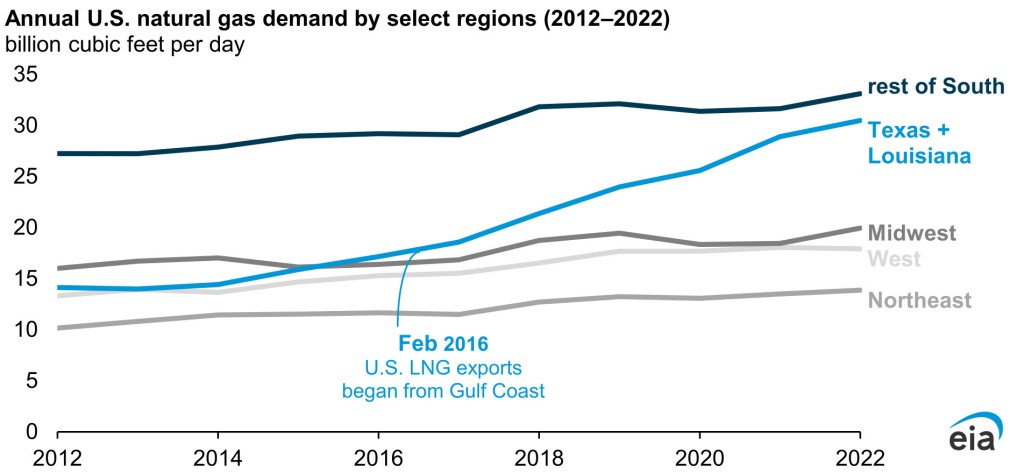
The U.S. LNG export industry began in 2016 when the Sabine Pass LNG export terminal launched in Cameron Parish, Louisiana. Since then, global demand for natural gas has increased drastically. From 2012 to 2022, the demand has grown by 116%.
However, LNG’s growth has allowed for its negative environmental effects to spread, specifically harming minority communities. Out of nine LNG terminals currently in operation in the continental U.S., five are clustered along the shoreline of Texas and Louisiana, according to a tracker created by the Sierra Club. In Texas, almost 16 million people live in the coastal region along the Gulf of Mexico; more than a third of that population is Hispanic and almost 17% are Black, according to a report from the Texas Comptroller.
LNG terminals are part of several oil and gas industries with operations along the coast of Texas and Louisiana, where residents often bear the brunt of both industrial pollution and the effects of climate change caused by burning fossil fuels.
Ozane, an internationally recognized environmental justice advocate and mother of six from southwest Louisiana, lost her home in 2020 to hurricanes Laura and Delta. The next year, she started the Vessel Project as a mutual aid and environmental justice advocacy group.
For Ozane, the pause on new LNG export operations is part of a larger push to prevent more polluting industries — including climate change-related tech like direct air capture, hydrogen, and carbon capture, and storage — from setting up shop in the same places that have already experienced so much harm.
“This decision is a big decision because it sets the foundation for us to get these projects stopped and not approved to come to our community,” said Ozane.
